
The 7-Step Process for Government Contracting Success
The Federal Sales Roadmap that leads to predictable repeatable results
Neil McDonnell
President, GovCon Chamber of Commerce
Founder, CallPlan.ai and GovCon in a Box

The 7-Step Process for Government Contracting Success
Are you struggling to grow your government contracting business — even though you’re doing everything “right”?
You don’t need to work harder. You need to follow the process.
The 7-Step Process for Government Contracting is a proven framework guiding small businesses from early market research through opportunity qualification, proposal development, and long-term sales success. .
Stop guessing. Start following the same 7-Step process that has helped over 2,500 small businesses win contracts, grow sustainably, and create economic security and success for your family.
“Government contracting is not a secret. It is just a process.
Follow the process from 'A to Z' to create predictable, repeatable revenue.”
In This Guide
- Watch the Video Training
- Who This Is For
- Why The 7 Step Process Matters for 2026
- Step 1 — Research
- Step 2 — Targeting
- Step 3 — Outreach
- Step 4 — Strategic Relationships
- Step 5 — Opportunities
- Step 6 — Proposals
- Step 7 — Sales
- Will This Process Work for You?
- Neil’s Insider Perspective
- Your First Month Using the 7-Step Process
- Download the 7-Step Process Workbook
- About Neil McDonnell
Watch: The 7-Step Process to Win Federal Contracts
In this video training, Neil walks you step by step through his 7-Step Process for government contracting success..
Who is This Sales Framework For?
The 7 Step Process for Government Contracting is for government contractors doing $1M–$50M in annual revenue who need predictable, sustainable federal sales.
If you're competing against larger contractors with deeper resources, your advantage is focus and relationships, not scale.
Neil's 7 Step Process works because it aligns with how agencies actually buy from small businesses.
Why Does The 7 Step Process Matter in 2026?
Federal buying is speeding up and consolidating, while programs like small-business goals and set-aside allocations are getting less predictable, which means more competitors chasing fewer, larger deals. If you wait for SAM.gov and respond with a generic or AI-polished proposal, you are already late and less competitive.
- Shorter timelines: Market research, RFI, and RFP cycles are compressing, so if you are not in the conversation early, you never see the real opportunities.
- AI noise: Agencies are starting to see look-alike, AI-generated proposals, so they put more weight on mission understanding, shaping, and relationships that happen long before submission.
- Tighter budgets and more scrutiny: With pressure to move faster and prove value, buyers favor small businesses that already understand the mission and feel low-risk, not those who show up cold at RFP time.
The 7-Step Process is the solution. Follow the roadmap to show up earlier, stay visible, and be the obvious, low-risk choice when the government is ready to award.
The 7-Step Process for Government Contracting
-
Step 1 — Research
Understand one agency better than your competitors do.
Research reveals mission priorities, challenges, modernization goals, funding movement, and aligned opportunities. Referencing actual agency language instantly elevates your credibility.
At a minimum, review public documents and combine what you learn from tools like SAM.gov, FPDS, USAspending, strategic plans, and budget justifications. The SAM.gov guide shows how to turn registrations and notices into real market insight.
-
Step 2 — Targeting
Build a focused list of 100–200 contacts inside one agency ecosystem.
This list should include all three SPIN Selling roles (as described in Neil Rackham’s work and expanded in Neil’s article on how small businesses develop agency relationships):
- Focuses of Receptivity — people willing to explain environment and context
- Focuses of Dissatisfaction — program owners who feel the mission pain and influence requirements
- Focuses of Power — contracting officers and acquisition authority
Strong targeting ensures you have visibility, insight, and access.
-
Step 3 — Outreach
Secure short meetings that lead to information-sharing and referrals.
Outreach is intentional, personal, focused, and disciplined. A successful meeting ends with a next step, deeper discussion, or a referral.
-
Step 4 — Strategic Relationships
Outreach is the path to building your mutual growth group of 24 strategic relationships.
The 24 strategic relationships include your peers, your target agency (e.g., the Army), and that agency’s preferred prime contractors:
- 8 small businesses
- 8 large prime contractors
- 8 federal agency contacts
These relationships lead to early awareness, technical insight, teaming options, and mission credibility.
-
Step 5 — Opportunities
Only slam-dunk opportunities belong in your pipeline.
A slam-dunk opportunity:
- aligns with your core competency
- sits inside your target agency
- matches your past performance
- involves people who know you
- gives you a chance to shape the requirement early
Winners qualify out more than they qualify in.
-
Step 6 — Proposals
Your goal is not to write compliant proposals. Your goal is to write winning proposals.
Winning proposals are:
- clear
- compliant
- compelling
- convincing
You cannot write strong proposals without intel, relationships, or context.
-
Step 7 — Sales
Sales is learning, refining, and improving every cycle.
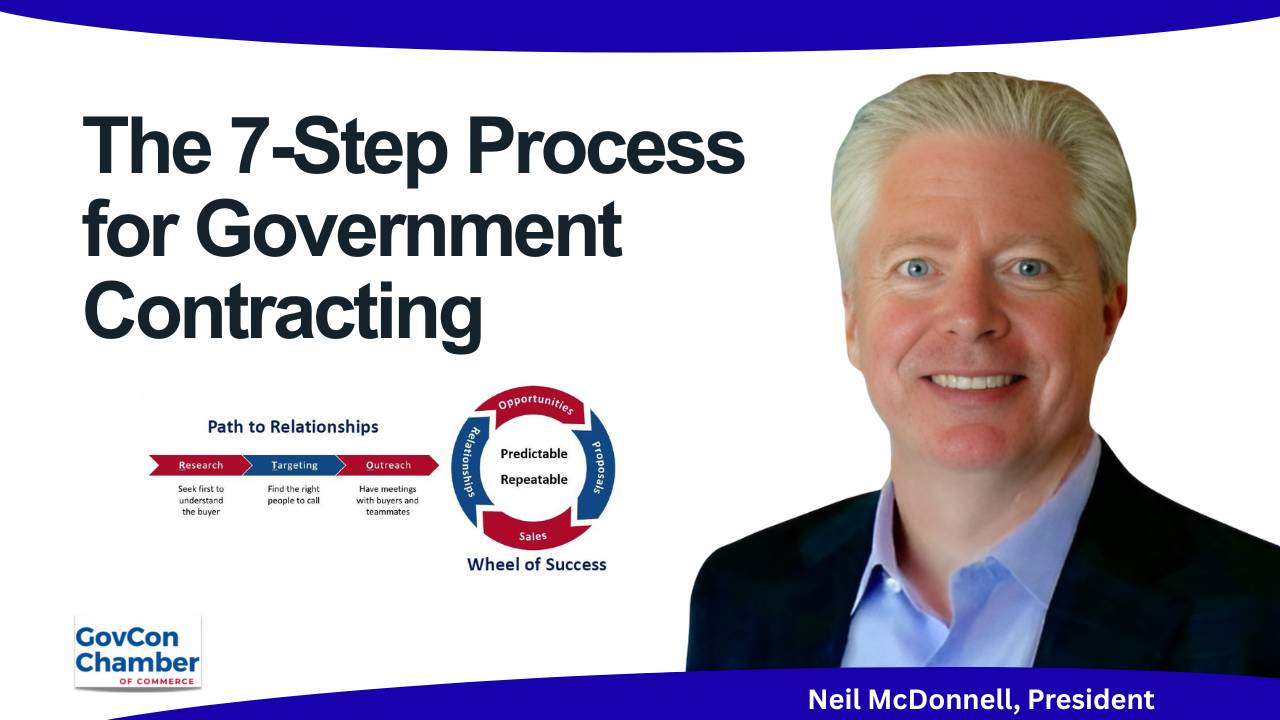
This step begins the Wheel of Success — where relationships generate opportunities, opportunities produce proposals, and wins deepen relationships.
Why The 7 Step Process for Government Contracting Will Work for You
Most contractors jump straight into proposals. They chase every opportunity, gather no intel, and write without context.
The 7-Step Process forces the steps that actually produce wins:
- Research the mission
- Target the right people
- Outreach that earns meetings
- Relationships that build trust
- Opportunities you can shape
- Proposals grounded in insight
- Sales that refine the cycle
Successful small businesses prioritize Steps 1–3. They understand the buyer before they ever sell to them.
Next, they invest in 24 'strategic relationships' (see Step 4) so they are never competing cold.
This structure consistently improves win rates because it builds context, relevance, and trust before the formal competition begins.
Neil’s Insider Perspective
Government buyers have been telling Neil the same things for 20 years. If you want to compete seriously for government contracts, this is what they want you to understand.
- Be visible! Update your SBA Small Business Search database and SAM.gov profiles.
- Register in our agency portals so we can find your company.
- Do your homework! Research, target and outreach to agency specialists.
- Lead with your capabilities, not your tags (ie HUBZone, WOSB, VOSB)
What do contracting officers and agency leadership complain about most?
- Small businesses show up without researching the agency's mission
- Companies don't take the time to read the agencies strategic plan or communications to industry
- Companies don't take the time to update their SBS/DSBS and SAM.gov profiles (looks like you don't pay attention to important details)
- Websites and LinkedIn profiles contradict capability statements
When this happens, buyers avoid meetings and dodge your phone calls. They don't have time to waste.
Your First Month Using the 7-Step Process
Here’s a realistic first month that gets you moving without overwhelm.
Task 1 — Align Your 2026 Marketing Assets
Review and update your SBS/DSBS, SAM.gov profiles, capability statement, website government page, LinkedIn personal and company pages. All of your marketing assets must communicate your unique niche and value proposition in the same way:
- Capability narrative
- Core competencies
- NAICS priorities
- Anchor keywords
Task 2 — Research One Government Agency
Study their strategic plan, budget, GAO/IG reports, FPDS/USASpending patterns, and recent SAM.gov activity. Document where you truly fit.
Task 3 — Build Your Target List
Identify receptive guides, problem owners, and decision authorities inside that agency.
Task 4 — Begin Outreach
Schedule brief calls, ask focused questions, and ask for one referral in each conversation. This is where momentum begins.
Download the 7-Step Process for Government Contracting Workbook
The workbook includes:
- Agency Research Checklist
- Targeting Worksheet
- 24-Relationship Tracker
Download the 7-Step Process for Government Contracting Playbook (PDF)
About Neil McDonnell
Neil McDonnell is the president of the GovCon Chamber and one of the most respected small-business advocates in the federal market. A former Army Ranger with a 25-year career running 3 of his own contracting business. Neil is a federal sales expert.
Since 2018, he has delivered more than 700 LinkedIn Live federal sales trainings and worked directly with over 2,500 small businesses, teaching them how federal buyers make decisions and what drives contract awards.
Neil McDonnell 's 7-Step Process for Government Contracting has become a trusted roadmap across DoD, VA, DHS, HHS, GSA, and civilian agencies, helping companies move from chasing random opportunities to building predictable, repeatable pipelines.
As a national GovCon speaker and trainer, Neil is recognized for his clarity, humor, and pragmatic strategies His work strengthens communication between government buyers, prime contractors, and small businesses.

Frequently Asked Questions
FAQ as of December 6, 2025. Federal budgets and policies change frequently; confirm details against current official sources.
1. What are the biggest federal budget shifts affecting small business contractors in 2025–2026?
Two major trends matter most for small businesses:
- Deep proposed cuts and restructuring in health and domestic programs. The Trump Administration’s FY 2026 budget proposal would substantially reduce funding for the Department of Health and Human Services and cut the CDC/ATSDR budget by more than half, while consolidating programs into new entities.
- Rescissions and tighter topline funding for State/foreign operations and civilian accounts. Congress has enacted rollbacks on prior-year appropriations, effectively shrinking the pool of available dollars.
Sources: TFAH Report (Sept 2025), OMB FY 2025 Budget, CRS FY 2025 SFOPS.
2. Which agencies are most impacted by proposed cuts, and how does that affect opportunity?
Agencies facing the greatest pressure include:
- CDC and portions of HHS: Proposed reductions of 50%+ to core public health programs and movement of functions into new structures.
- State/USAID: Rescissions and reduced foreign operations budgets tighten funding for overseas development and diplomacy work.
- Other domestic programs: Public media and select social/health programs face rollbacks or elimination.
Small businesses must identify mission areas that are still funded or expanding—cyber, health IT, modernization, and mission-critical operations.
Sources: TFAH Analysis, The Guardian Coverage, CRS SFOPS.
3. How much is defense spending increasing, and what does that mean for small businesses?
Defense budgets remain comparatively strong:
- DoD funding remains in the mid-$800B range—flat to modest growth—with priority on cyber, AI, infrastructure, and readiness.
- While CRs and rescissions create friction, the demand signal for defense contractors remains high.
Small businesses that clearly map their offerings to defense mission needs can still build a healthy pipeline.
Sources: Federal News Network, OMB Budget.
4. How will budget constraints affect federal contractors over the next 12–24 months?
Expect three realities:
- Higher competition for fewer, larger awards. Agencies are consolidating requirements and reducing contract volume.
- Greater emphasis on past performance and risk. Buyers rely more on vendors who already know the mission.
- Less tolerance for random proposals. Vendors who skip Research, Targeting, and Outreach lose to those who shape early.
5. Where do construction and infrastructure opportunities look strongest?
Even under budget pressure, demand remains steady for:
- Facilities modernization and energy-efficiency upgrades (HVAC, lighting, controls).
- IT and network infrastructure to support cloud, AI, cyber, and modernization initiatives.
- Resilience and preparedness projects tied to climate risk, base hardening, and COOP.
Sources: FedBiz Access, Government Technology Insider.